If you’re thinking about retraining into the construction trades, the first question is rarely “where do I sign up?” It’s “which trade?” And that’s a much harder question than it looks.
We hear this question a lot. It comes from career changers, school leavers, people made redundant from office jobs, people whose bodies are telling them their current work isn’t sustainable. Almost all of them arrive with the same worry: what if I pick the wrong one?
The honest answer is that “do what you love” isn’t useful here. Most people don’t know what they’d love about a trade until they’ve spent some time in it. What actually helps is thinking practically about four things, and then narrowing down from there.
Four things to think about before you pick
1. The shape of the work itself
Trades vary more than people realise. Some are mostly indoors, some are mostly outdoors. Some are fine-detail work where a millimetre matters — joinery, kitchen fitting — and others are heavier, more physical. Some put you in teams on busy sites; others are quieter, often working alone or with one mate. Before anything else, ask yourself which of those sounds like a good day at work, and which sounds like a bad one.
2. Your life and your body
This is the part people skip, and it matters more than the romantic version of the job. How far are you willing to travel for work? Are early starts a problem? Is your back, your knees, your hearing in good shape — and how much do you need it to still be in good shape in twenty years? Some trades are kinder on the body than others. Be honest with yourself about what you can sustain, not just what sounds good now.
3. The market you’re stepping into
Demand isn’t uniform. Some trades have steady, predictable work; others are more boom-and-bust. Some are quietly growing — anything tied to retrofit, insulation, or the move to lower-carbon buildings is in a different position from where it was even five years ago. Pay ranges also vary widely depending on whether you’re employed, self-employed, or working through agencies.
4. Where you’re starting from
What you already know, what you’ve already done, and how much time you can give to training all narrow the field. A multi-trade course makes sense if you’re starting from zero and want a broad foundation. A specialist course makes sense if you’ve already got transferable skills or you know exactly what you want. Either is a solid starting point — they’re just different paths.
A short, honest tour of the trades we teach
Here’s a quick look at what we offer at Cornerstone, and the kind of person each course tends to suit. Roughly, our six trades split into two outcome routes: self-employed trades (Kitchen Fitting, Plastering, Joinery, Tiling) where you finish ready to start trading on your own; and employed trades (Roofing, Solar PV) where we introduce you to hiring employers as standard.
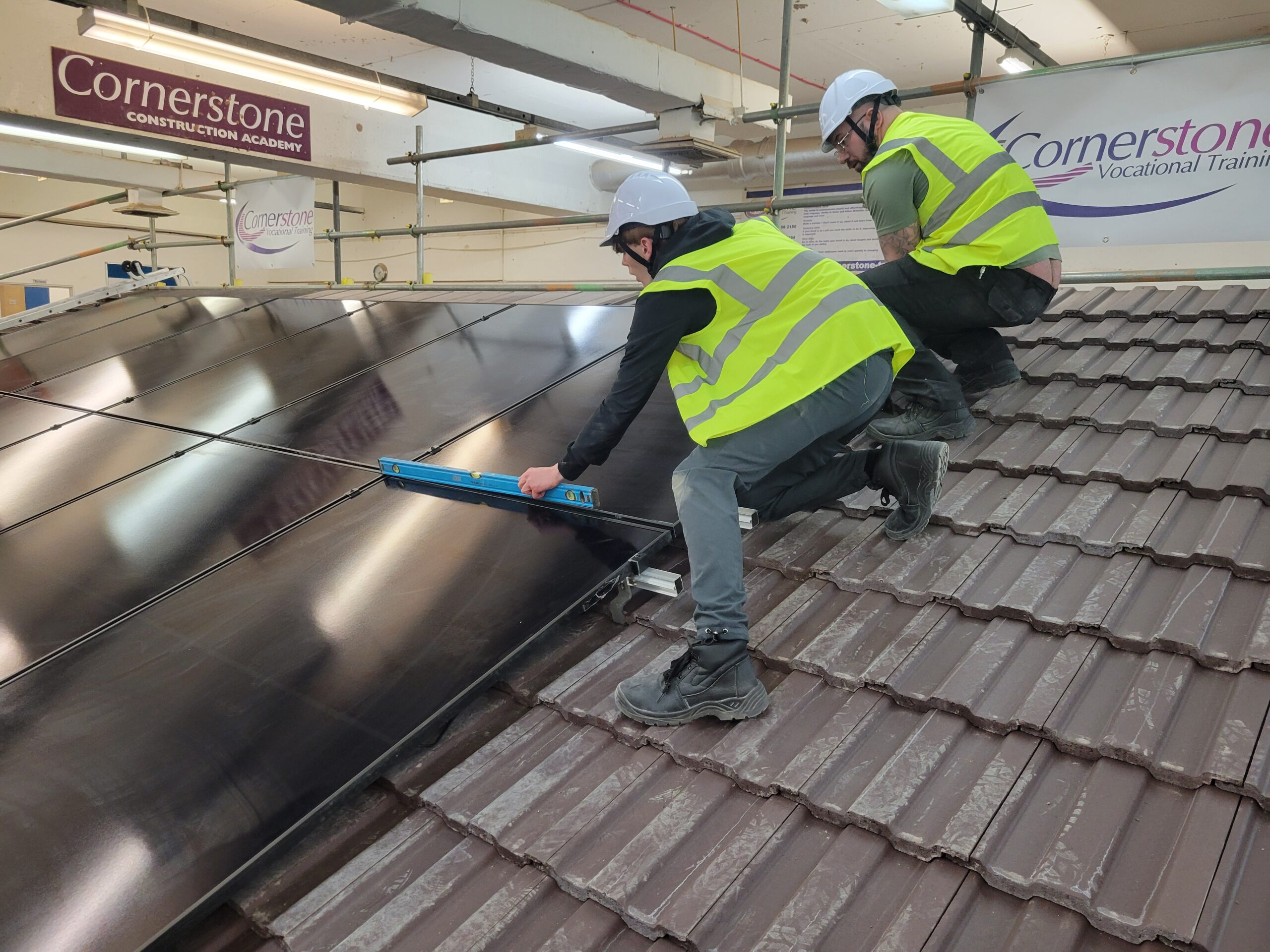
Solar PV Installation. If you want to be part of the energy transition and you’re comfortable working at height, this is a genuinely growing field. Our course covers the roofing side of solar PV — surveying, mounting, weatherproofing, routing cables to the loft — which is the part most solar installer firms are short of right now. The electrical connection from the loft onwards is a separate, electrician-only job.
Kitchen Fitting. Suits people who like detailed, finishing work and don’t mind working in customers’ homes. Often involves talking to clients, so it helps if you’re comfortable doing that. Good route to self-employment.
Joinery. One of the oldest and most respected trades. Patient, precise, materials-driven work. Suits people who get satisfaction from making things properly. Can be site-based or workshop-based depending on the path you take.
Plastering. Physical and rhythmic. Plasterers tend to either love it or move on quickly — it’s a craft, but a demanding one. Steady work, good for self-employment, and there’s real pride in the finish.
Roofing. Tough, weather-dependent, and one of the trades where there’s consistent regional demand. If you’re comfortable working at height and don’t mind being outside in all conditions, roofing offers a clear route into employment with established firms — and it’s the natural foundation if you want to move into solar PV later.
Tiling. The finishing trade in every kitchen and bathroom. Precise, methodical work, with steady demand across renovation, new-build, and commercial fit-out. Well suited to working for yourself, and one of the trades with the clearest pathway from learner to qualified tiler.
How to actually decide
Read about a few trades. Watch some honest videos of people doing the work — not the highlight reel, the real thing. If you can, find someone in the trade and ask them what their week actually looks like. Most tradespeople are happy to talk about their work if you ask.
When you’re ready to start mapping out a plan, our free Resources page has a 12-week Career Action Planner you can download — it’ll help you set goals and stay accountable while you decide.
And if you’d like to talk it through with us, we’re happy to do that. Picking the right trade is a real decision with real consequences, and we’d rather you take your time and get it right than rush into the wrong course.
Leave a Reply